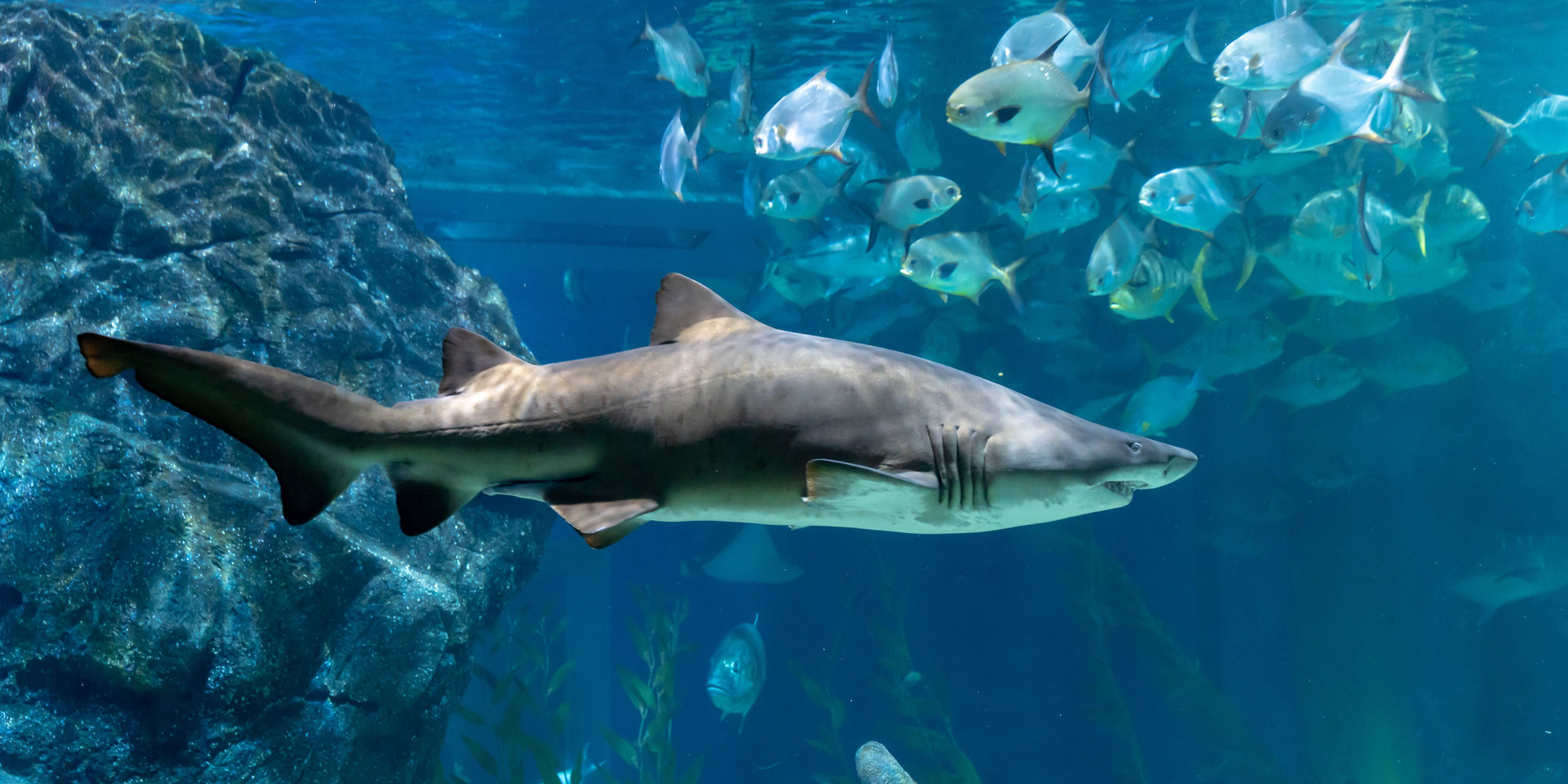


Sand Tiger Sharks sport a ferocious look thanks to the rows of large, pointed teeth that remain visible when their jaws are shut. Their movement, however, is relatively slow and they are the only shark species known to gulp and store air inside their stomachs to maintain a neutral buoyancy while swimming.
Sand Tiger Sharks have sleek, grey backs, dirty white undersides, and brown or reddish spots on their sides. These sharks can reach an impressive length of 5.5 m, though most average around 3.6 m.
Animal Type
Cartilaginous fish
Range
Circumtropical; except Eastern Pacific
Natural Habitat
Coastal Waters
Diet
Fish, cephalopods, crustaceans
Conservation Status
Not Evaluated
Extinct
Critically Endangered
At extremely high risk of extinction
Find out more
Characteristics
Feeding behaviour
Sand Tiger Sharks are nocturnal hunters with a surprising strategy—they sometimes work together to catch prey. By grouping up, they herd fish into small groups, making it easier for each shark to strike and feed.
Threats faced/Conservation
Sand Tiger Sharks have one of the lowest reproduction rates of all shark species, making even the smallest threat a danger to the population too. They face fishing pressure across their range, targeted as both catch and bycatch. Their preference for inshore habitats also puts them at risk from coastal habitat loss and degradation.
Conservation Status
Not Evaluated
Species yet to be assessed
Data Deficient
Insufficient data for evaluation
Least Concern
At lower risk of extinction
Near Threatened
Likely to become threatened in the near future
Vulnerable
At high risk of extinction
Endangered
At very high risk of extinction
Critically Endangered
At extremely high risk of extinction
Extinct in the Wild
No longer found in the wild, survives only under human care
Extinct
No longer exists