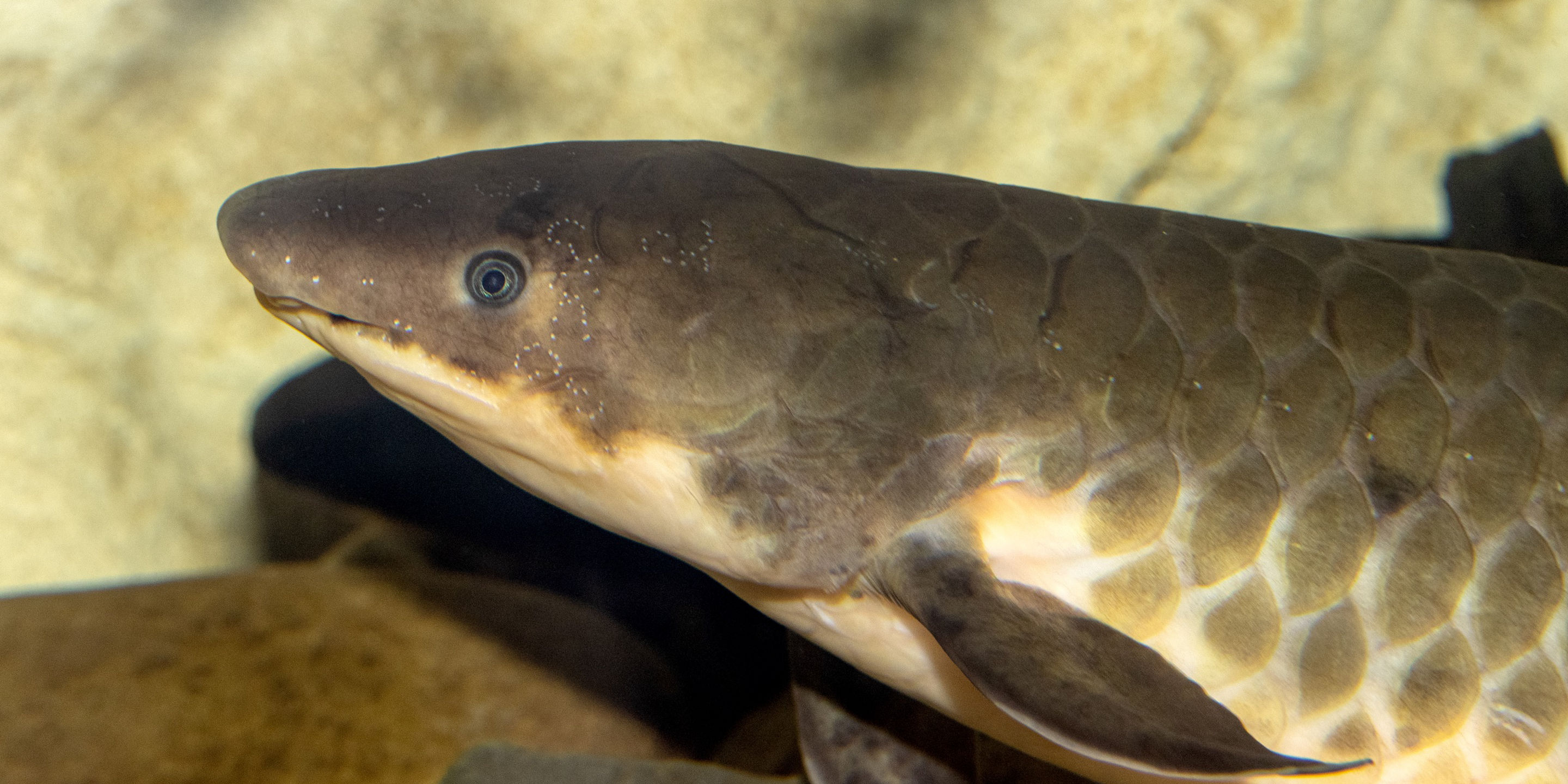


Unlike other lungfish species that have paired lungs, Australian Lungfish have a single lung with many blood vessels. They primarily rely on their gills for breathing, only using their lung when in poorly oxygenated waters.
With fossil records tracing back approximately 380 million years, Australian Lungfish are considered the most primitive of the six lungfish species alive today. They are endemic to the Burnett River and Mary Rivers in Queensland, Australia.
Animal Type
Bony Fish
Range
Australia: Burnett River, Mary River
Natural Habitat
Freshwater Habitats
Diet
Fish, crustaceans, frogs
Conservation Status
Not Evaluated
Extinct
Endangered
At very high risk of extinction
Find out more
Characteristics
Feeding behaviour
Australian Lungfish are carnivorous, nocturnal hunters with limited vision. Instead of relying on sight, they use their sense of smell and electroreception to detect weak electric fields emitted by prey. Typically foraging near plant matter at night, they feed on a variety of aquatic animals, including frogs, small fish, tadpoles, snails, shrimp, and earthworms.
Threats faced/Conservation
Facing growing pressure from habitat loss and the decline of breeding sites due to human activities, Australian Lungfish are listed as Endangered in the IUCN Red List. Capture without a permit is prohibited, and strict rules are in place to regulate their trade.
Conservation Status
With fossil records tracing back approximately 380 million years, are considered the most primitive of the six lungfish species alive today. They are endemic to the Burnett River and Mary Rivers in Queensland, Australia.
Not Evaluated
Species yet to be assessed
Data Deficient
Insufficient data for evaluation
Least Concern
At lower risk of extinction
Near Threatened
Likely to become threatened in the near future
Vulnerable
At high risk of extinction
Endangered
At very high risk of extinction
Critically Endangered
At extremely high risk of extinction
Extinct in the Wild
No longer found in the wild, survives only under human care
Extinct
No longer exists