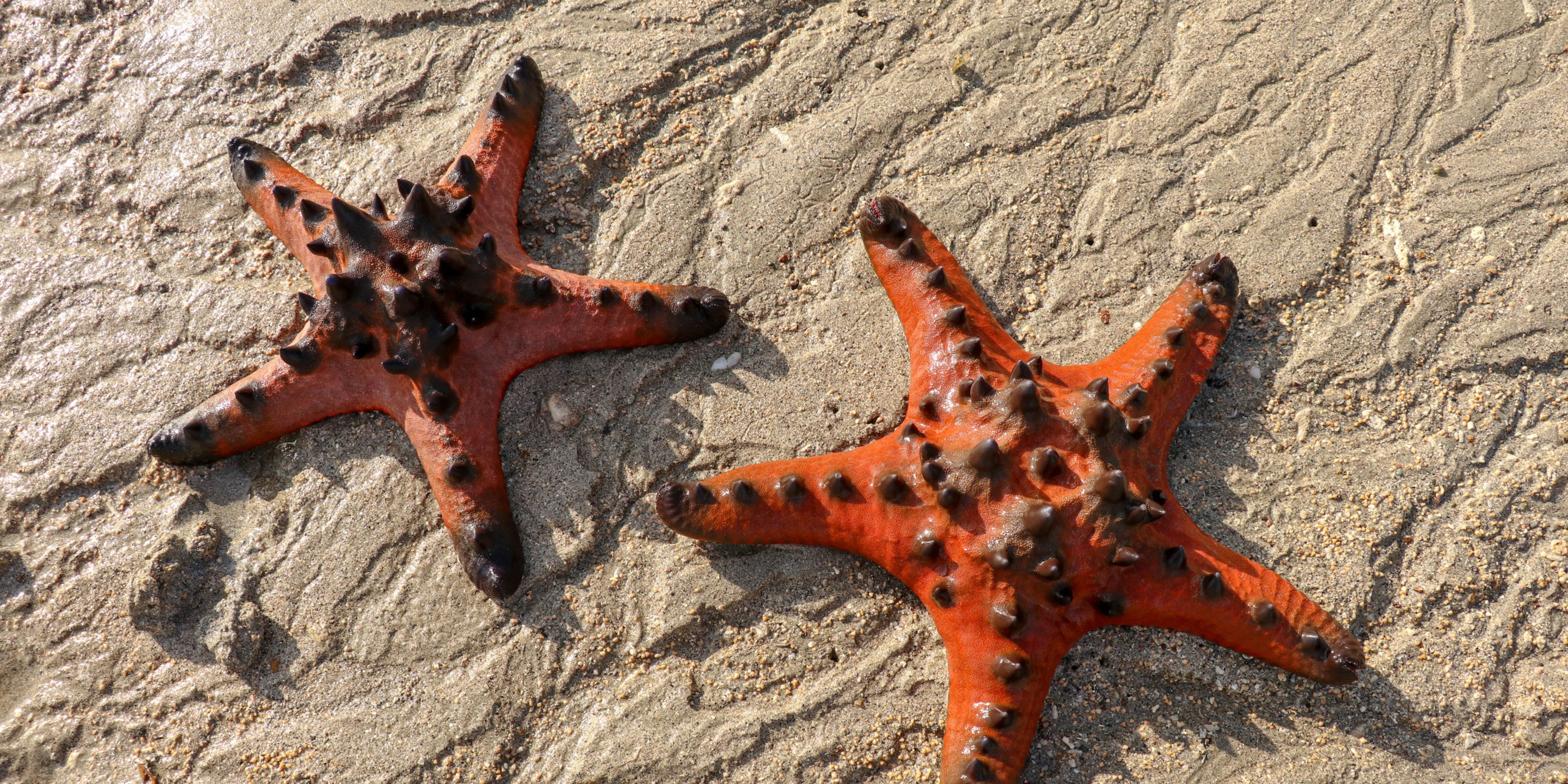


The water vascular system of Knobbly Sea Star does more than just circulate nutrients—it also enables them to move. Thousands of tiny tube feet project from their underside. As water moves through their bodies, it creates shifts in pressure that may cause the tube feet to expand or contract. Sea stars can cling on to surfaces through vacuum and coordinate their feet to move slowly over substrates.
Knobbly Sea Stars are named for the conical 'knobs' on their bodies. These protrusions look like chocolate chips, earning them the nickname 'chocolate-chip sea stars', but they also deter predators.
Animal Type
Echinoderm
Range
Indo-West Pacific
Natural Habitat
Intertidal Zone
Diet
Algae, molluscs, detritus
Conservation Status
Not Evaluated
Extinct
Not Evaluated
Species yet to be assessed
Find out more
Characteristics
Feeding behaviour
These sea stars feed on relatively large prey using a clever strategy called extra-oral feeding. With the help of their tube feet, they pry open shells and push their stomach out through their mouth to begin digestion. Once softened, the food is pulled back into their body, allowing the sea star to finish digestion and absorb nutrients.
Threats faced/Conservation
Knobbly Sea Stars play a vital role in reef ecosystems and are an important bioindicator species for reef health. However, as their habitats are near the shore, they are vulnerable to degradation and human disturbance. This species is listed as Endangered in the Singapore Red Data Book.
Conservation Status
Not Evaluated
Species yet to be assessed
Data Deficient
Insufficient data for evaluation
Least Concern
At lower risk of extinction
Near Threatened
Likely to become threatened in the near future
Vulnerable
At high risk of extinction
Endangered
At very high risk of extinction
Critically Endangered
At extremely high risk of extinction
Extinct in the Wild
No longer found in the wild, survives only under human care
Extinct
No longer exists