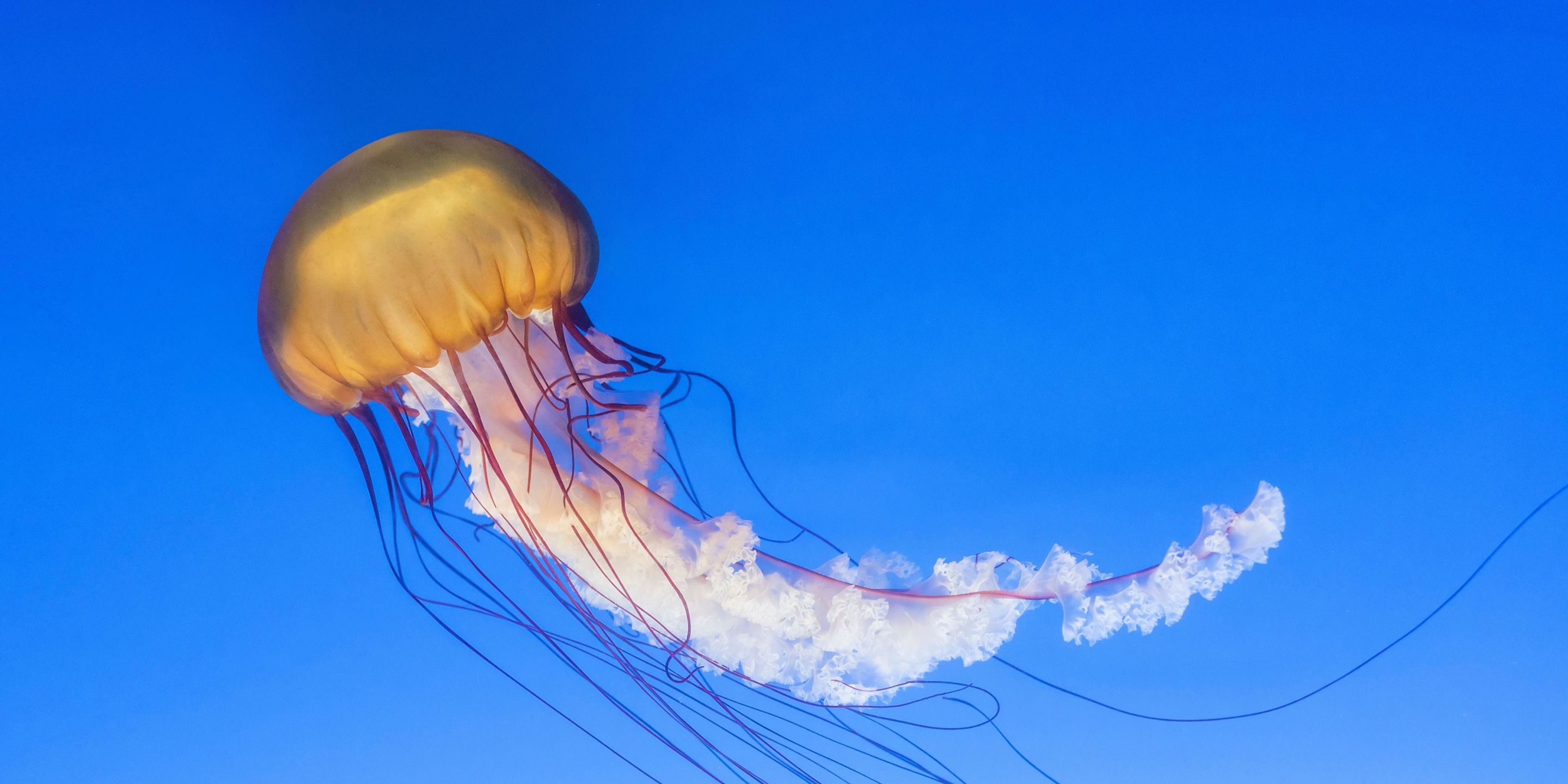


The bell of a Pacific Sea Nettle holds the tools it needs for navigation. It contains muscles that contract and expand, creating a backward thrust and an outward jet of water that facilitate movement. Light-sensing “eye spots” help differentiate light and dark, while statocysts—sensory structures—maintain the sea nettle’s orientation as they drift through water.
Vividly red stinging tentacles and frilly oral arms trail from a dusky red bell. This explains how their species name fuscescens came about.
Animal Type
Cnidarian
Range
Eastern Pacific
Natural Habitat
Open Ocean
Diet
Plankton
Conservation Status
Not Evaluated
Extinct
Not Evaluated
Species yet to be assessed
Find out more
Characteristics
Feeding behaviour
Pacific Sea Nettles use their exceptionally long tentacles to catch prey. Their stinging tentacles are lined with stinging cells that inject a toxin to stun their prey, which are then moved to the mouth by their oral arms. As they search for food, Pacific Sea Nettles move up and down through the water, sometimes travelling over 1 km in a day to follow prey that migrate with changing light.
Threats faced/Conservation
An important part of the food web, this species is a crucial food source for marine animals like sea turtles. But plastic pollution puts these predators at risk. Floating plastic bags can look like sea jellies and may be swallowed by mistake, leading to serious or even fatal health problems.
Conservation Status
Not Evaluated
Species yet to be assessed
Data Deficient
Insufficient data for evaluation
Least Concern
At lower risk of extinction
Near Threatened
Likely to become threatened in the near future
Vulnerable
At high risk of extinction
Endangered
At very high risk of extinction
Critically Endangered
At extremely high risk of extinction
Extinct in the Wild
No longer found in the wild, survives only under human care
Extinct
No longer exists