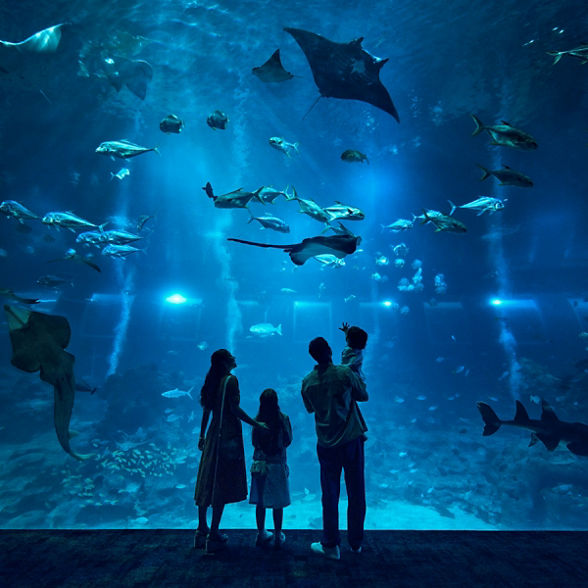
Venture to the seafloor and discover the fascinating marine animals that have specially adapted to life below, among shipwrecks and manmade structures.
- Open Ocean Currents
- Migrators
- Benthos
- Artificial Habitats
Open Ocean Currents
Step into the flow of the ocean’s great highways, where powerful currents shape life beneath the surface. Open Ocean Currents reveals this endless movement, where marine animals navigate ever-changing waters in perfect harmony.
Schools of fish shift and swirl, their synchronized movements brought to life through projection mapping, mirroring the ocean’s natural rhythms. The Sargassum habitat showcases a drifting ecosystem rich with life, home to species like the Sargassum fish, Mysid shrimp, and Japanese Big Eye, each uniquely adapted to life on the move.
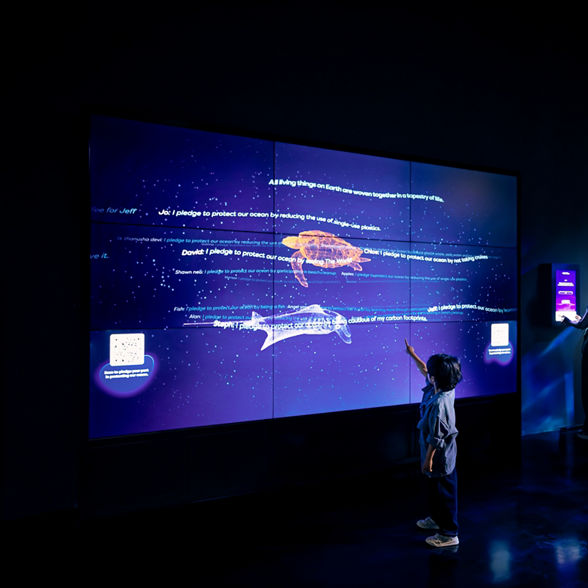
But not everything carried by the currents belongs in the sea. The ‘Garbage Patch’ art installation traces the path of a single discarded plastic bottle as it drifts across the ocean, a stark reminder of human impact on these waters.

Migrators
As twilight descends over the open ocean, life stirs in the depths. In a cycle as old as the sea itself, marine creatures rise from the darkness below while others embark on journeys stretching across entire oceans. Vertical Migrators and Horizontal Migrators bring these extraordinary movements to life, offering a rare window into the travellers of the deep.
The Vertical Migrators habitat reveals species that move with the changing light, like the Japanese Pineapplefish whose bioluminescent glow likely helps it communicate with others of its kind or camouflage. Alongside them, the Horizontal Migrators habitat highlights ocean wanderers like the Indo-Pacific Bottlenose Dolphins, navigating vast distances with precision honed by generations.
Every migration is a story of survival, resilience, and instinct. In this space, these stories unfold, revealing the silent travellers that shape the ocean’s endless rhythm.
This zone extends beyond the water with Tidal Trove offering merchandise designed to inspire discovery and learning, as well as Tide Deli which provides a quick refuel with light bites, energising those eager to continue their journey through the deep.


Benthos
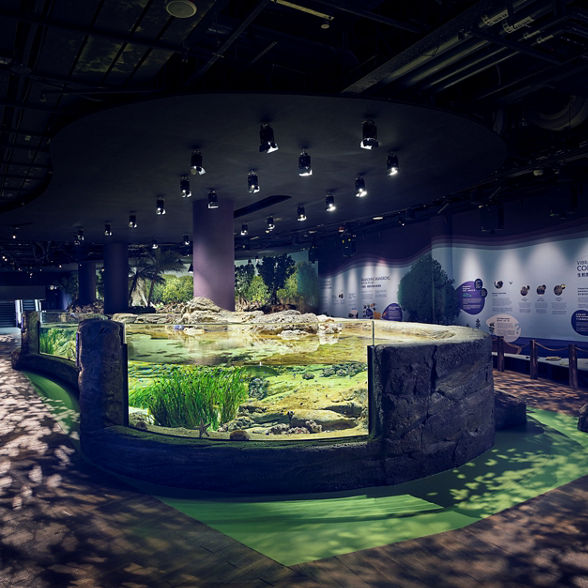
Traveling deeper, the sun fades, revealing the natural wonders found near the bottom of the shallow seas. At Benthos, experience this diverse community of marine life that thrives in this environment through a series of live habitats where elusive Green Morays weave through rocky crevices and formidable Tasmanian Giant Crabs navigate terrain. A cylindrical habitat brings the reef to life, teeming with species like the Banggai Cardinalfish and Yellow Tang, each playing a role in this underwater community.
At the Art-quarium – an interactive touch table, visitors can mix different traits to create their own digital fish, while learning how these adaptations help marine species survive in their environment.
Whether it is experiencing vibrant marine life up close, or creating unique species digitally, there’s something for everyone here.


Artificial Habitats
Artificial reefs provide a second chance for marine life to flourish. These human-made structures – whether shipwrecks, sculptures, or purpose-built reef formations – offer shelter, breeding grounds, and food sources for a diverse array of species. Over time, they become thriving ecosystems, supporting marine biodiversity in ways that mimic natural reef formations.
Here, the Artificial Habitats encompasses a walkthrough tunnel and a viewing panel where the likes of Indo-Pacific Leopard Sharks and Blotched Fantail Rays glide through the remnants of a sunken vessel. Beyond the shipwreck, explore replicas of artificial habitats developed with insights from researchers and conservationists. These structures demonstrate how science and innovation come together to create sustainable environments for marine species. Witness how even the smallest crevices in these formations provide refuge for a wide range of marine animals like the Bonnethead Shark among others.
The journey continues with a glimpse into history at the Bakau Wreck, where artifacts from the past highlight how shipwrecks not only tell human stories but also become lifelines for marine ecosystems and make the zone come alive.
Whether uncovering the past or shaping the future of marine conservation, this is a space to discover, learn, and be inspired by the resilience of ocean life.