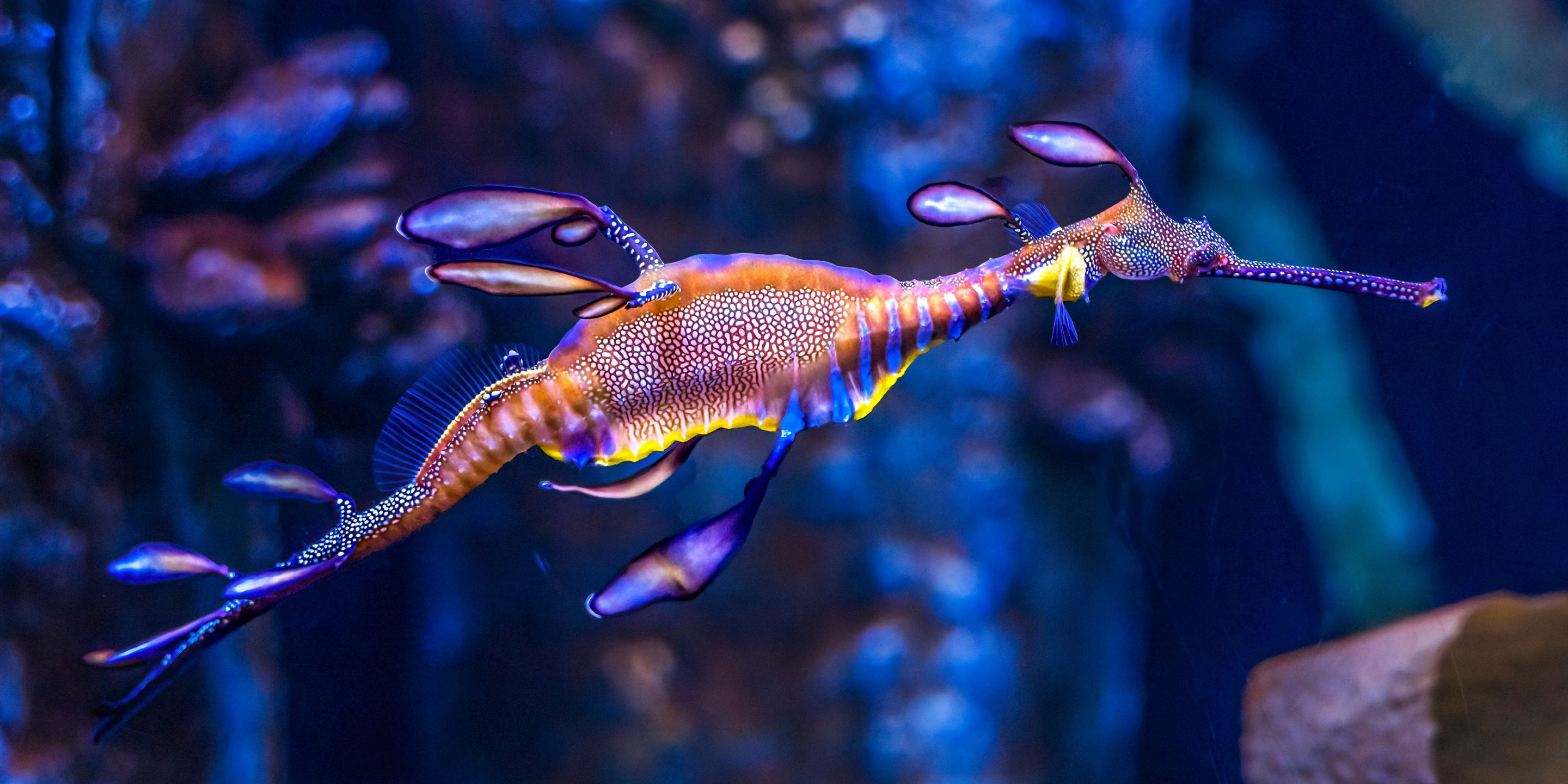


Male seadragons are dedicated fathers that brood and nourish around 250 to 300 fertilised eggs in a brood patch on the underside of their tails. When these eggs are deposited, the seadragon’s skin forms a cup around each of them. After 30 to 38 days, the eggs hatch, and the young rely on their yolk sacs for two to three days before beginning to hunt independently.
Weedy Seadragons are named for the leafy appendages along their bodies, resembling seaweed. Their vibrant camouflage helps them blend into their coastal habitats like kelp forests, seagrass meadows, and coral reefs.
Animal Type
Bony Fish
Range
Eastern Indian Ocean
Natural Habitat
Coastal Waters
Diet
Crustaceans, plankton
Conservation Status
Not Evaluated
Extinct
Vulnerable
At high risk of extinction
Find out more
Characteristics
Feeding behaviour
Seadragons have long, tubular, toothless mouths that can suck up a prey whole by expanding a joint in the lower snout. Their keen eyes can move independently of each other, aiding in precise hunting. Using pivot feeding, they rapidly rotate their snouts with the help of elastic recoil of tendons to catch small, fast-moving prey with remarkable accuracy.
Threats faced/Conservation
Found only around Australia, this species is affected by the ongoing degradation and loss of coastal habitats. Seagrass meadows and coral reefs are declining in both quality and size due to human activities, threatening the survival of Weedy Seadragons that rely on them for shelter and protection.
Conservation Status
Not Evaluated
Species yet to be assessed
Data Deficient
Insufficient data for evaluation
Least Concern
At lower risk of extinction
Near Threatened
Likely to become threatened in the near future
Vulnerable
At high risk of extinction
Endangered
At very high risk of extinction
Critically Endangered
At extremely high risk of extinction
Extinct in the Wild
No longer found in the wild, survives only under human care
Extinct
No longer exists